

Australian Books Publisher is Adelaide's trusted full-service book publishing company. From ghostwriting and editing to cover design, ISBN registration, printing, and global distribution — we help authors across Australia bring their books to life.

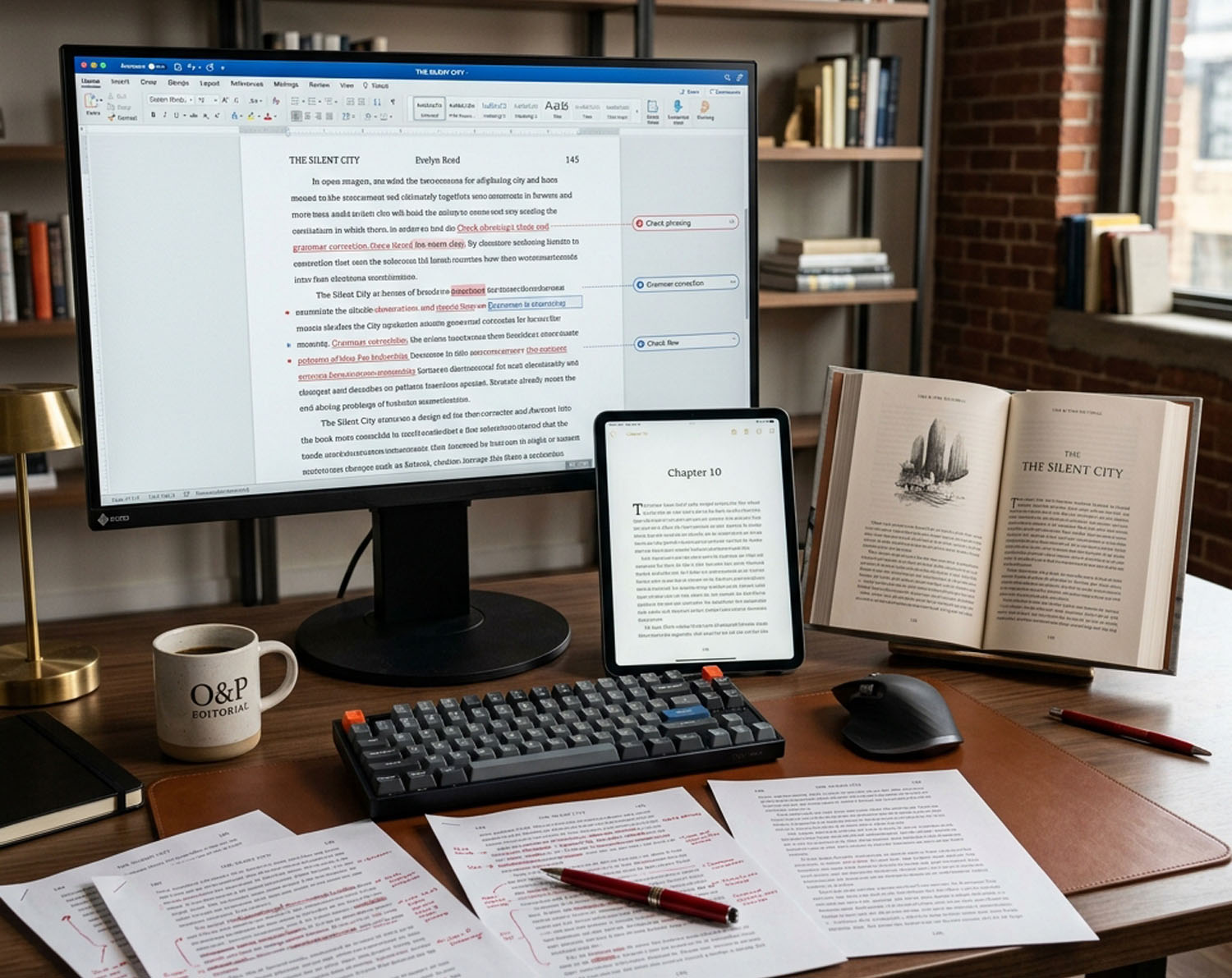
Professional manuscript editing showing structural revisions and line edits

WHY "GOOD GRAMMAR" IS THE SMALLEST PART OF EDITING

Most first-time authors think editing means fixing typos and comma placement. That is proofreading — the last and smallest stage of the process, and honestly the easiest to get right. The editing work that actually determines whether readers finish your book, leave a good review, and recommend it to friends happens much earlier: at the structural level, where a manuscript's pacing, character logic, and argument flow either work or do not.

Here is a pattern we see constantly: an author submits a technically clean manuscript — correct spelling, correct punctuation, grammatically sound sentences — and it still does not work as a book. Chapter three introduces a character trait that contradicts chapter twelve. The midpoint has no tension because the stakes were never properly established. A non-fiction book jumps between unrelated ideas without transitions, leaving readers lost. None of these are grammar problems. They are structural problems, and no amount of proofreading fixes them. This is why editing has to be treated as several distinct skills, not one single pass.
THE THREE EDITING PASSES YOUR BOOK ACTUALLY NEEDS

Developmental editing comes first and cuts deepest — this is where an editor looks at your manuscript the way an architect looks at blueprints, not the way a proofreader looks at a finished wall. For fiction, that means examining character arcs, pacing, plot logic, and whether the story's stakes escalate convincingly. For non-fiction, it means checking whether your argument builds logically, whether each chapter earns its place, and whether the structure actually serves the reader instead of just reflecting how the ideas occurred to you while writing. This stage often produces the most uncomfortable feedback — "this subplot needs to go," "your protagonist's motivation in Act 2 does not track" — but it is exactly the feedback that separates books readers finish from books they abandon at chapter four.

Copy editing comes next, working at the sentence and paragraph level: tightening prose, fixing consistency issues (a character's eye colour changing between chapters is more common than you would think), correcting Australian English spelling and grammar conventions, and smoothing awkward phrasing without flattening your voice. Proofreading is the final safety net — the last read-through hunting for the small errors that survive everything else: a missing word, a doubled "the," an inconsistent chapter heading style. Skipping any of these three stages, or collapsing them into one rushed pass, is the single most common reason self-published books read as unpolished even when the writer is genuinely talented.

Structural, copy editing and proofreading stages for a manuscript

HOW WE EDIT YOUR MANUSCRIPT — STEP BY STEP

A structured process built around what your specific manuscript actually needs, not a one-size-fits-all pass.

01
Manuscript Diagnostic (Free Sample Edit)

Before quoting you a timeline or scope, we edit a sample chapter — usually 1,500 to 2,000 words — free of charge. This shows you exactly how we work, what kind of feedback to expect, and honestly tells us how much developmental work your manuscript needs versus how close it already is to publish-ready. No author should commit to a full editing project without seeing the editor's actual work first.

02
Editor Matching by Genre

A thriller editor and a memoir editor read for completely different things — pacing and tension versus emotional honesty and narrative arc. We match your manuscript to an editor who works regularly in your specific genre, not whoever happens to be free that week. This matters more than most authors realise; an editor unfamiliar with genre conventions can flatten exactly the elements that make your book distinctive.

03
Developmental Editing Pass

Your editor reads the full manuscript and delivers a structural edit letter — typically 3 to 8 pages — addressing plot logic, pacing, character or argument development, and any structural issues, alongside in-manuscript comments at the specific points they occur. You get both the big-picture assessment and the exact locations where changes matter, not a vague summary that leaves you guessing what to actually fix.

Manuscript editing process from developmental edit to final proofread
04
Author Revision Window

You take the developmental feedback and revise your manuscript on your own timeline — this is not a rush job, because meaningful structural revision takes real thinking time. Your editor remains available during this window for questions about specific feedback points. Once you are satisfied with your revisions, the manuscript moves to the next stage.

05
Copy Editing & Line Editing

With the structure locked, we move to sentence-level work: tightening prose, correcting Australian English grammar and spelling conventions, fixing continuity errors (names, timelines, physical details that shift inconsistently), and refining word choice and rhythm. Every change uses tracked edits, so you see exactly what changed and why — nothing is silently altered without your visibility.

06
Final Proofread & Sign-Off

A separate proofreader — not the same person who did the copy edit, because fresh eyes catch what familiar eyes miss — performs the final pass, hunting for any remaining typos, punctuation errors, or formatting inconsistencies. Once this is complete, your manuscript is ready to move into formatting and publishing.

Manuscript editing process from developmental edit to final proofread
Author reviewing structural edit letter and manuscript feedback
Professionally edited manuscript ready for publishing

Why We Give You a Free Sample Edit Before Any Commitment

Editing is deeply personal — an editor is about to spend hours inside your story, and their notes will directly shape how the final book reads. Choosing an editor based only on a website description or a price quote is a genuine gamble; you have no way to know if their instincts match your vision until you see their actual notes on your actual pages. That is why we edit a real sample from your manuscript before you commit to anything. If our feedback resonates and you can see it strengthening your work, we move forward together. If it does not feel right, you walk away having lost nothing but a few minutes of our time — and you will have a clearer sense of what to look for wherever you go next.

Take The World By Storm

We have helped businesses, amateurs, and best-selling authors formulate incredible works of biographies, comic books, and more!

Customer
Testimonials

Our customers are at the forefront of everything we do.

Hire The Best Writers and Illustrators To Take Your Story To The Next Level

Share your creativity with the world.

get started

Work With Us

Frequently Asked Questions
Frequently asked questions about professional book editing services in Australia